Unvented Cylinder Installation in London
A new unvented cylinder installation in London is a fixed £2,400, covering pipework, installation, commissioning and Building Regulations. No VAT is charged. The cylinder is priced separately, chosen by type, size and your preference. The discharge route is planned first, because it decides whether the house can take an unvented cylinder.
What the visit covers
- Whether your mains pressure and flow can support an unvented cylinder
- What the inlet group, expansion vessel, relief valve and tundish each do
- Why the discharge route is planned before the cylinder is ordered
- Building Regulations Part G and what to ask any installer for
- Questions to put to any installer before you accept a quote
Fixed prices
What it costs
- New cylinder installation
- Pipework, installation, commissioning and Building Regulations. Cylinder priced separately.
- £2,400Plus cylinder
- Cylinder troubleshooting and diagnosis
- No call-out fee.
- £180Fixed price
No VAT is charged
There is no call-out fee
Cylinder price depends on type, size and your preference; we recommend the right one.
Order of work
Survey the supply and the space
A competent survey measures static pressure and flow at the cylinder position, pipe size, floor loading and where a visible discharge can safely run to.
Choose the cylinder to suit
Capacity, direct or indirect, heat source and whether the mains can support an unvented unit at all.
Fit and connect to the manual
The cylinder is levelled and connected, with the inlet group, expansion vessel and discharge route fitted to the manufacturer instructions and Part G.
Commission and hand over
Safety valves are tested and the first heat cycle is watched. Ask what record and notification the installer will give you.
What does a new unvented cylinder installation cost?
A new unvented cylinder installation is a fixed price of £2,400. It includes pipework, installation, commissioning and Building Regulations, which are self-certified through a competent person scheme. No VAT is charged, and there is no call-out fee.
The cylinder is not in that figure. It is priced separately, from a price list by type, size and your preference, and we recommend the right one for your home and your mains supply. We cover London inside the M25, 24/7.
For how typical UK quotes are built up, see the unvented cylinder installation cost guide. Every fixed price sits on the pricing page.
| Item | Fixed price | Priced separately | Notes |
|---|---|---|---|
| Pipework, installation, commissioning, Building Regulations | £2,400, No VAT is charged | No | Self-certified through a competent person scheme |
| The unvented cylinder itself | Not in the fixed price | Yes | Chosen by type, size and your preference; we recommend the right one |
| Call-out | There is no call-out fee | No | Diagnosis of an existing fault is a separate fixed price |
| VAT | No VAT is charged | No | Shown beside every price |
Can my house take an unvented cylinder?
That question comes before the choice of cylinder. An unvented unit takes its pressure from the incoming main, so a weak main means a weak shower whatever the cylinder cost. Every manufacturer publishes its own minimum pressure and flow, and the installation manual for the model you are considering is where to find it. A high pressure reading does not guarantee flow, so both should be measured with the cold taps running.
An old narrow supply pipe, or a flat several floors up, can pass the pressure test and still fail on flow. Then the honest answer may be a vented cylinder with a pump, or a thermal store. The comparison is in vented vs unvented cylinders.
The space matters too. A full 210 litre cylinder holds 210 kilograms of water before the metal is counted, which is why a loft or first-floor cupboard should be checked rather than assumed. What the space needs is covered on the hot water cylinder airing cupboard page.
What goes in an unvented installation?
Under Part G of the Building Regulations an unvented hot water storage system must carry safety devices beyond the ordinary thermostat. Each has its own page, and the set is the same on every installation.
The expansion vessel is pre-charged to suit the supply pressure, so a vessel charged for one pressure and fitted to a supply set for another will discharge every time the water heats. The settings come from the manufacturer's manual for that model. An indirect cylinder fed by a boiler also needs a motorised two-port valve wired to its overheat thermostat, so that a failed thermostat cuts the primary flow. No thermal cut-out or safety wiring is ever bypassed.
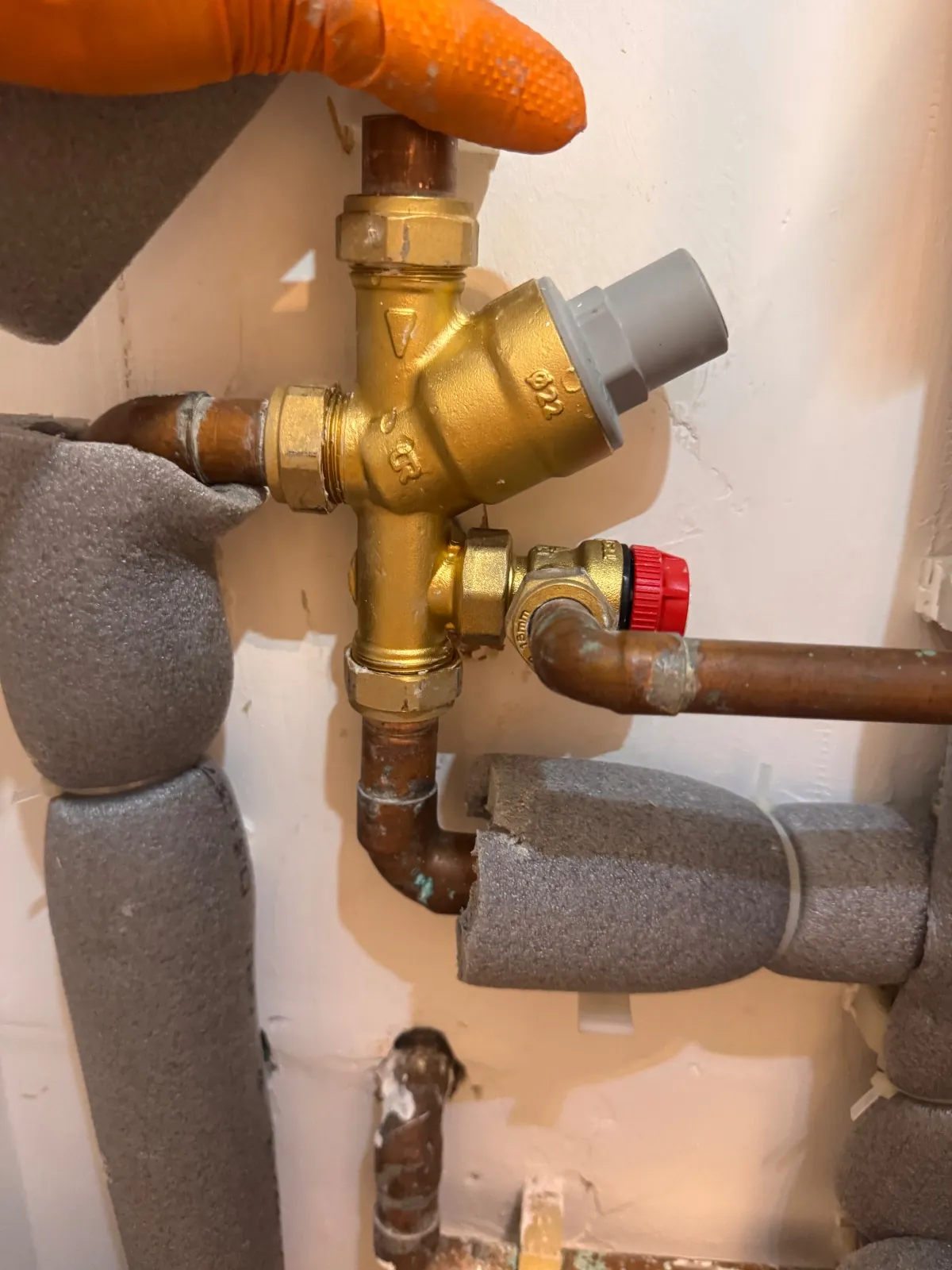
- Inlet group: strainer, pressure reducing valve, expansion relief valve and non-return valve, usually supplied as a combination valve for an unvented cylinder.
- Expansion vessel: takes up the extra volume as water heats, see the unvented cylinder expansion vessel page.
- Safety valve: the temperature and pressure relief valve, factory fitted on the cylinder and not relocated.
- Tundish: the visible air gap where a discharge shows, described on the unvented cylinder tundish page.
- Discharge route: the pipe from the tundish to a safe termination, covered in unvented cylinder discharge pipe.
Why is the discharge route planned first?
The tundish and discharge pipe are where a fault becomes visible, and Approved Document G sets requirements for where the tundish sits, how the pipe falls and where it ends. The exact dimensions are in the current approved document and the manufacturer's manual, and an installer should be able to show you which they have worked to.
A boiler room with no drain, a ground-floor flat with no accessible gully or a long run with several bends may fail the sizing table. Finding that out after the cylinder is delivered is expensive, so a competent installer plans the route first.
The finished system should let you see a discharge, because a dripping tundish is the first sign that a valve or the vessel needs attention.
Never cap, plug or restrict a tundish, discharge pipe or relief valve to stop a drip. A blocked safety discharge on a heated, pressurised cylinder is dangerous. Scalding water, or an unvented cylinder discharging steam or very hot water: turn off the heat source, keep clear and call an engineer.
Regulations, paperwork and who can do the work
Installing an unvented cylinder is notifiable work under Building Regulations Part G (Approved Document G, Sanitation, hot water safety and water efficiency). It should be carried out by a competent installer and reach building control, either directly before work starts or through a competent person scheme that self-certifies it. Building Regulations are included in the fixed price of a new installation. Expect certificate or notification evidence and a commissioning record from any installer.
This is why an unvented installation is outside DIY. The rules in plain terms are in unvented cylinder regulations under Part G.
What should you ask any installer before accepting a quote?
Unvented installation is regulated work, so a good quote answers a few questions in writing, set out below.
- Which scheme, or which building control route, covers the notification?
- What will you receive on completion: a certificate or notification evidence, and a commissioning record for the cylinder?
- Has the mains been tested for pressure and flow, not pressure alone?
- Where does the discharge pipe run, and can a discharge be seen?
- Are the valve group, expansion vessel and tundish included, or separate items?
If a quote does not mention notification or a discharge route, it is incomplete. Ask before you pay. This list is what to ask of any competent installer.
Questions people ask
How much does a new unvented cylinder installation cost?
A new unvented cylinder installation is a fixed price of £2,400, and no VAT is charged. It includes pipework, installation, commissioning and Building Regulations. The cylinder is priced separately by type, size and your preference, and we recommend the right one.
Do I need building regulations approval to install an unvented cylinder?
Yes. The work is notifiable under Part G. Either the installer works through a competent person scheme that self-certifies the job, or building control is told before work starts. Keep the evidence with your property papers.
Can I install an unvented cylinder myself?
Not safely. It is notifiable work that needs a competent installer, safety valves set to the manufacturer manual and a tested discharge route. Leave the valves and electrics to an engineer.
What qualifications does an unvented cylinder installer need?
Training on unvented hot water storage, and a way to notify the work, usually a competent person scheme. Ask what route they use before you accept a quote.
How long does it take to install an unvented cylinder?
It depends on the survey. A like-for-like unvented swap is shorter than a conversion from vented, which adds pipework, a discharge route and often electrical work. Ask the installer for an estimate after they have seen the site.
Does an unvented cylinder need registering?
The installation is notified to building control, directly or through a competent person scheme, and you should receive evidence of it. Manufacturers may also ask for the cylinder to be registered for its warranty.
Will my mains supply cope?
Check pressure and flow, not pressure alone. Manufacturers publish a minimum for each model. A supply that falls short can mean a vented cylinder with a pump is the better choice.