TPRV and Expansion Vessel Repair on Unvented Cylinders
Water at the tundish on an unvented cylinder comes from one of two relief valves. The expansion relief valve on the inlet group normally weeps as the water heats when the expansion vessel has failed. The temperature and pressure relief valve (TPRV) on the cylinder is the last-resort release. Neither is a householder repair.
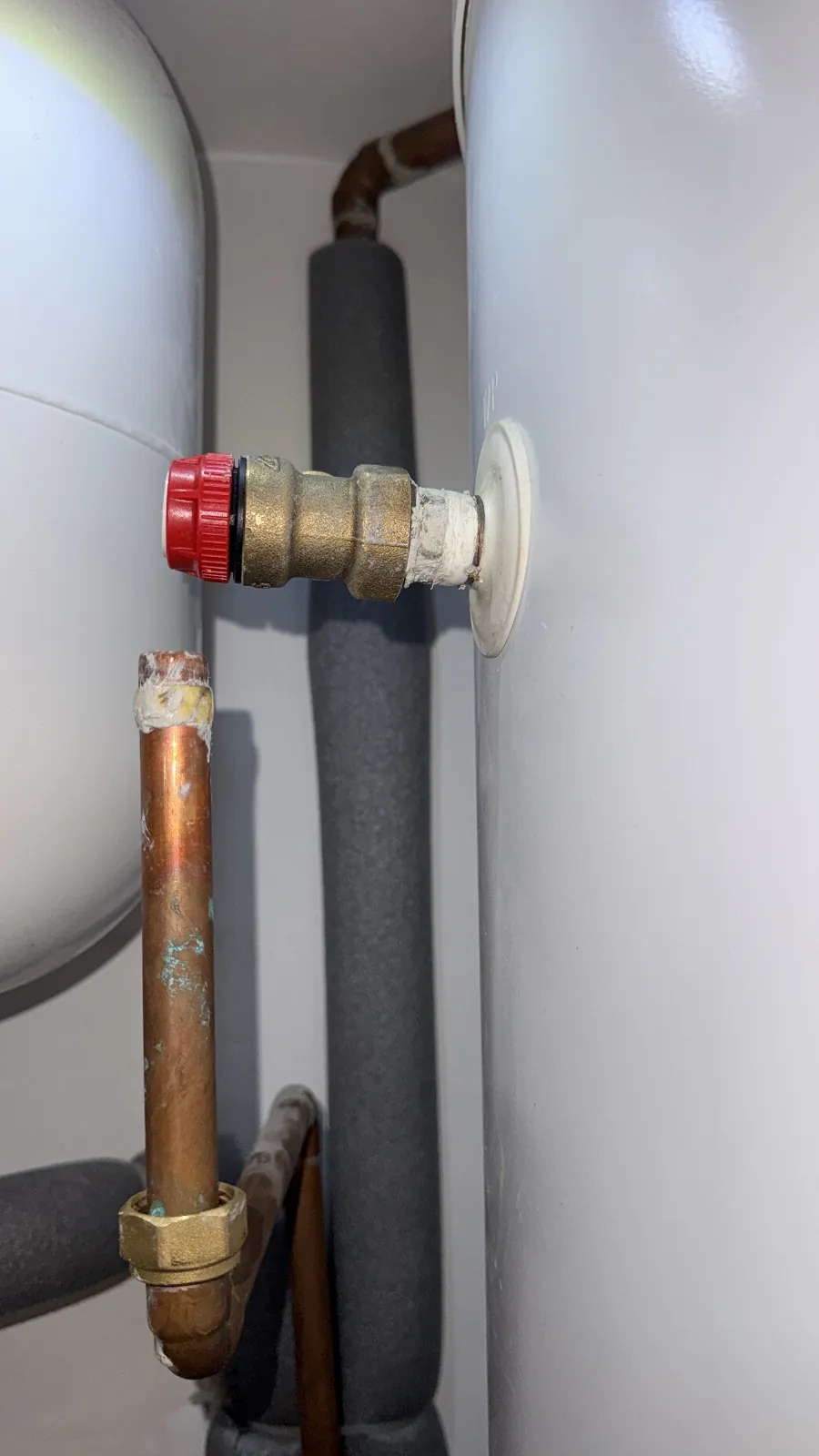
What the visit covers
- Telling the expansion relief valve from the TPRV by where it sits and when it discharges
- Reading continuous versus on-heat-up discharge at the tundish
- Testing, recharging or replacing the expansion vessel
- Replacing a valve or the whole valve group, only where the diagnosis supports it
- Tundish and discharge pipe checks
Fixed prices
What it costs
- Cylinder troubleshooting and diagnosis
- No call-out fee.
- £180Fixed price
No VAT is charged
There is no call-out fee
Order of work
Watch the discharge pattern
Continuous, only while heating, or only when a tap is opened. Each narrows the fault to a different part.
Isolate and relieve pressure
Heat source off and cold feed isolated, then pressure relieved before any part is touched.
Test the vessel before the valves
Vessel charge is checked with the water side relieved, then the valves are checked for passing seats and scale.
Replace only what failed, then retest
A valve or group is replaced if testing shows it, then the cylinder is refilled, vented and heated to prove it holds.
Which valve is discharging: the expansion relief valve or the TPRV?
An unvented cylinder has two separate relief valves, and they do different jobs. The expansion relief valve sits on the cold inlet group. It opens if the pressure in the cylinder rises past the rating stamped on it, which happens when expanding hot water has nowhere to go. The temperature and pressure relief valve (TPRV) is fitted on the cylinder itself. It is the last-resort release if the water gets too hot or the pressure climbs further.
Both discharge to the same tundish, the small funnel where the pipe breaks to air, so a drip there does not say which valve is responsible. Trace the discharge pipes back, or note the pattern. Water that appears only while the cylinder heats and stops as it cools usually means the expansion relief valve is lifting because the vessel cannot absorb the expansion. Water that runs constantly, heated or not, suggests a valve seat that is no longer sealing, or a pressure reducing valve letting too much pressure through.
Very hot water or steam from the TPRV discharge is different. That means the cylinder is overheating, a thermal control has failed, and the heat source should be isolated at once.
Discharging very hot water or steam? Switch off the heat source at the isolator, keep clear and call an engineer. Relief valves, the tundish and its pipe are never blocked, capped or adjusted.
How is an expansion vessel checked?
An expansion vessel is a sealed steel container split by a rubber diaphragm, with air on one side and water on the other. As the cylinder heats, the extra volume pushes into the vessel and compresses the air. The air side is pre-charged at the factory and the figure is on the vessel's data label. It is checked at the air valve with the water side relieved of pressure, because a reading taken while the cylinder is pressurised is false.
If the charge has dropped, recharging with air can restore it, and the vessel is watched afterwards. A vessel that loses its charge again, or that gives out water at the air valve, has a failed diaphragm and is replaced with one of the right size and rating for the cylinder, not any that fits.
Some cylinders use an internal air space instead of an external vessel, and a failing air space shows the same way. The cylinder make decides which applies, and the installation manual gives the charge or setting for your model. Use the figure on the label or in the manual, not one from a website.
When does the valve group need replacing?
Replacement follows the diagnosis, not the symptom. A vessel that has lost its charge makes a good expansion relief valve weep, and a new valve fitted beside a failed vessel will do the same within days. So the vessel is tested first, and a valve is replaced only where it is shown to be passing with the vessel sound.
Where a valve is shown to be at fault, the question is whether to replace the valve or the group. Valves in the same water tend to wear at similar rates, so some installers replace the combination valve and its nuts and olives together, and some replace a single cartridge or valve where the manufacturer sells it as a part. Either way, compression joints are remade with new olives, because an olive compressed once does not seal reliably again.
The relief valve is a safety device that limits the stored water temperature. Schedule 2 of the Water Supply (Water Fittings) Regulations 1999 requires a temperature relief valve, or a combined temperature and pressure relief valve, on unvented storage vessels of more than 15 litres, so that stored water cannot exceed 100 degrees Celsius. A valve that has failed to seat is replaced with the correct rating for the cylinder, never adjusted or plugged. Unvented work also falls under Building Regulations Part G and needs a competent installer.
What if a valve has been discharging for weeks?
Water running through the tundish for weeks is not harmless. Moisture can reach the cylinder base and the timber or floor under it, and damp or mould needs dealing with before new parts go in, so the repair is not undone.
Scale in the tundish or stopcock can also hide the true flow, and those parts are cleaned or replaced as part of the same job. The overall order of testing is on hot water cylinder diagnosis, and the other parts that can be repaired are on cylinder fault repair.
For a discharge that looks like a leak, cylinder leak repair shows how to tell the two apart, the unvented cylinders hub sets out the wider safety chain, and replacing both parts is priced in the TPRV and expansion vessel replacement cost guide.
Questions people ask
Why is my TPRV dripping on an unvented cylinder?
Check which valve it is. The discharge may come from the expansion relief valve, lifting because the expansion vessel has lost its charge. Constant dripping points at a valve seat, and dripping only on heat-up points at the vessel.
Can I turn off or cap a dripping relief valve?
No. Relief valves, tundish pipework and expansion devices are safety parts. Capping, adjusting or bypassing one removes the protection against overheated or over-pressurised water.
How do I know if my expansion vessel has failed?
Signs are discharge at the tundish as the cylinder heats, pressure surges at the taps, or water coming from the vessel air valve. It is confirmed by checking the charge with the water side relieved of pressure.
What pressure should the valves and vessel be set to?
The rating stamped on each valve and the figure on the vessel label or in the installation manual for your model. No single figure suits every cylinder, so a number from a website should not be used.
Is a dripping tundish an emergency?
Not by itself, but get it diagnosed promptly. If it starts discharging steam or very hot water, treat that as a thermal control failure and isolate the heat source.